
Best Firewood Moisture Meters (2026): Check Wood Is Under 20% Before It Burns
Moisture meters for firewood compared: General Tools MMD4E, Mecurate, TOPTES TS-630, LASELION MS03 and Wintact, with how to test wood against the EPA's 20% mark.
Affiliate disclosure: product links on this page go to Amazon or to the maker's own store. As an Amazon Associate we earn from qualifying purchases, at no extra cost to you; links to makers' own stores earn us nothing. No retailer or brand sees our picks before they are published or has any say in them. How we choose.
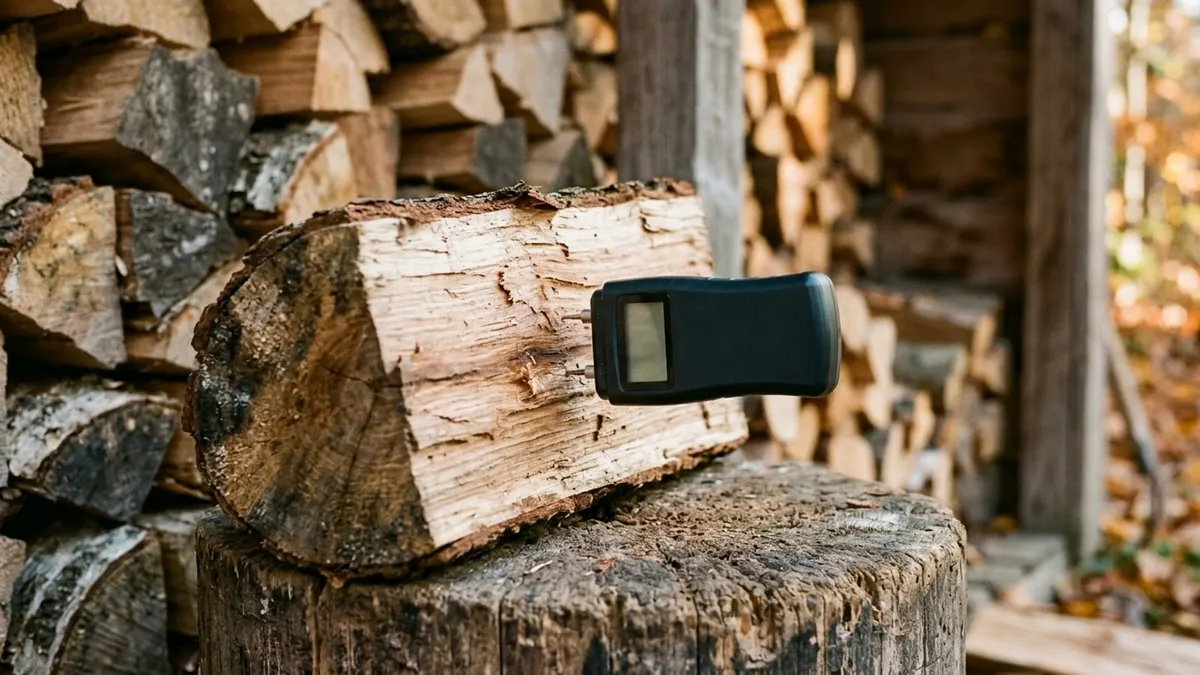
Wet wood is the main cause of smoky fires, creosote and lost heat. The EPA says wood burns best at less than 20% moisture, to test it with a wood moisture meter before burning, and to season it for at least six months. A meter costs little and settles the question in seconds; the picks below are pin and pinless meters that read the moisture range firewood falls in.
General Tools' MMD4E is our pick: a pin meter with a 5 to 50% wood range, a backlit display, spare stainless pins and a cap that doubles as a calibration check (per the listing).
Our top picks at a glance
- General Tools MMD4E Moisture Meter
Type: Pin · Wood range: 5 to 50% · Scales: Wood and building materials · Display: Backlit LCD
- Mecurate Pin Type Wood Moisture Meter
Type: Pin · Wood range: Not stated · Scales: 8 wood scales · Display: Backlit, 3 colors
- LASELION MS03 Pin and Pinless Moisture Meter
Type: Pin and pinless · Wood range: 0 to 75% · Scales: Wood and building materials · Display: LCD with hold
- Wintact Pocket Pin Moisture Meter
Type: Pin · Wood range: 6 to 70% · Scales: 4 wood, 3 building · Display: LCD
| Pick | Type | Wood range | Scales | Display | Buy |
|---|---|---|---|---|---|
| General Tools MMD4E Moisture MeterBest overall | Pin | 5 to 50% | Wood and building materials | Backlit LCD | Amazon |
| Mecurate Pin Type Wood Moisture MeterBest for species | Pin | Not stated | 8 wood scales | Backlit, 3 colors | Amazon |
| LASELION MS03 Pin and Pinless Moisture MeterBest pin and pinless | Pin and pinless | 0 to 75% | Wood and building materials | LCD with hold | Amazon |
| Wintact Pocket Pin Moisture MeterBest pocket meter | Pin | 6 to 70% | 4 wood, 3 building | LCD | Amazon |
Best overall
General Tools MMD4E Moisture Meter
A pin meter with a calibration-check cap.
- Type
- Pin
- Wood range
- 5 to 50%
- Scales
- Wood and building materials
- Display
- Backlit LCD
Pros
- Cap doubles as a calibration checker (per the listing)
- Spare 8 mm stainless pins
- Includes a 9 volt battery
Cons
- Single wood scale (per the listing)
- Pins leave small holes
General Tools' MMD4E reads 5 to 50% in wood and 1.5 to 33% in building materials on a backlit display with 0.3 inch digits, and comes with extra 8 mm stainless pins, a protective cap that doubles as a calibration checker, and a 9 volt battery (per the listing).
Its 5 to 50% range spans everything from green wood to well seasoned (per the listing; our reading).
Best for species
Mecurate Pin Type Wood Moisture Meter
Eight wood scales for different species.
- Type
- Pin
- Wood range
- Not stated
- Scales
- 8 wood scales
- Display
- Backlit, 3 colors
Pros
- 8 calibrated wood scales (per the listing)
- Low, medium and high color indicators
- 0.1% resolution
Cons
- Range not given in the listing
- Need the manual's species list
Mecurate's pin meter has a wood mode with eight calibrated scales for different wood types, listed in its manual, plus a building material mode, 0.1% resolution and three colored indicators for low, medium and high moisture (per the listing).
Matching the scale to the species improves the reading for dense hardwoods (per the listing; our reading).
Best pin and pinless
LASELION MS03 Pin and Pinless Moisture Meter
Pin and pinless modes in one meter.
- Type
- Pin and pinless
- Wood range
- 0 to 75%
- Scales
- Wood and building materials
- Display
- LCD with hold
Pros
- Two measuring modes (per the listing)
- Built-in flashlight
- Hold function
Cons
- Accuracy ±4% under ideal conditions (per the listing)
- Pinless reads the surface layer
LASELION's MS03 has pin and pinless modes and reads 0 to 75% in wood and 0 to 25% in building materials, with a hold function and a flashlight; the listing gives accuracy of ±4% under ideal conditions.
Pinless mode scans without marking the wood, while pins reach inside a split face (per the listing; our reading).
Best pocket meter
Wintact Pocket Pin Moisture Meter
A small pin meter with a firewood-friendly range.
- Type
- Pin
- Wood range
- 6 to 70%
- Scales
- 4 wood, 3 building
- Display
- LCD
Pros
- ±2% accuracy, 0.1% resolution (per the listing)
- 1.58 ounces
- Auto power-off
Cons
- Short 0.38 inch probes
- Small display
Wintact's WT660 reads 6 to 70% in wood with 0.38 inch probes, ±2% accuracy and 0.1% resolution, with four wood ranges and three for building materials, and weighs 1.58 ounces (per the listing).
TOPTES's TS-630 is a larger alternative with a 2.25 inch tricolor display and seven scales from 0 to 57% (per the listing).
How to test firewood
- Split a piece from the middle of the stack (our reading).
- Press the pins into the fresh split face, across the grain, rather than the weathered ends or bark (our reading).
- Use the scale for the species if the meter has one (per the listings).
- Test several pieces; burn the batch only when the readings sit below 20%, the EPA's figure.
Reading the number
| Reading | What to do |
|---|---|
| Below 20% | Ready to burn (EPA) |
| 20% and up | Leave it to season longer, split and off the ground (EPA) |
| Fresh-cut wood | Season at least six months before testing again (EPA) |
Meters differ, so use the species scale where the meter has one and test several pieces rather than trusting one reading (per the listings; our reading).
Calibration
General Tools ships the MMD4E with a cap that doubles as a calibration checker, and Mecurate and Wintact use several scales for different woods (per the listings). Check the meter against its calibration cap or reference at the start of each season, and replace weak batteries, which can skew readings (per the listings; our reading).
Seasoning
The EPA says to season wood for at least six months, split it small so it dries faster, and store it outdoors, off the ground, with only the top covered, since covering the sides traps moisture. Seasoned wood is darker, weighs less and sounds hollow when knocked against another piece, the EPA adds; the meter confirms it.
Wood species
US Stove's manual points owners to firewood heat charts, including one from Utah State University's forestry extension, to compare how species burn. The EPA suggests softwoods or less dense hardwoods such as maple for starting a fire, and US Stove says air-dried hardwoods give higher efficiency and lower emissions once it is going.
When to test
- When firewood is delivered, before you pay for seasoned wood (our reading).
- In autumn, before the first fires, for wood cut last winter (our reading).
- Whenever a fire smokes or the glass blackens fast, which can mean wet wood (EPA; our reading).
Why it matters
The EPA says to burn only dry, well-seasoned wood and never wet or green wood, and US Stove says air-dried hardwoods give higher efficiency and lower emissions than green wood. Dry wood also builds less creosote; see the chimney sweep guide.
Speeding up drying
The EPA says split wood seasons faster because more surface is exposed, and that smaller pieces load and burn better too. It also suggests knocking bark off before bringing wood in, since some bark resists fire, and putting the split side toward the flame (EPA).
Other uses
Most of these meters also read walls and building materials: General Tools' MMD4E reads 1.5 to 33% in materials such as drywall and concrete, and LASELION's MS03 0 to 25% (per the listings). That makes one meter useful for firewood in winter and for leaks and damp walls the rest of the year (our reading).
Pin or pinless
Pin meters measure resistance between two probes pushed into the wood, while pinless meters scan the surface without marking it (per the listings; our reading). For firewood, pins in a fresh split face give the most useful reading, since the inside of a log dries last (our reading).
Testing pellets
Pellets are made far drier than firewood: US Stove's standard asks for under 8% moisture, which is below the range most firewood meters are built to read well, so a meter is mainly a firewood tool (US Stove; per the listings; our reading).
Battery and care
Pin meters need their probes kept clean, dry and straight; General Tools ships spare pins and a protective cap, and Wintact offers auto power-off to save the battery (per the listings). Store the meter dry and away from the stove's heat between uses, with the cap on (our reading).
Which to choose
- A simple, accurate firewood check with a calibration cap: General Tools MMD4E (per the listing).
- Mixed species from different trees: Mecurate, with eight wood scales (per the listing).
- Firewood and walls without marking the surface: LASELION MS03 (per the listing).
- A pocket meter for the woodpile: Wintact WT660 (per the listing).
Buying firewood
Take a meter when buying firewood sold as seasoned. The EPA also asks buyers to burn locally cut wood so invasive pests do not travel. Storage is covered in the firewood rack guide.
Frequently asked questions
What moisture should firewood be?
Below 20%, the EPA says, tested with a wood moisture meter before burning.
How do I use a moisture meter on firewood?
Split a piece and press the pins into the fresh face across the grain; test several pieces (our reading).
How long does firewood take to season?
At least six months, the EPA says, split and stored off the ground with only the top covered.
Are pinless moisture meters good for firewood?
They scan the surface; pins in a fresh split face read the inside, which dries last (our reading).
Can I tell dry wood without a meter?
The EPA says seasoned wood is darker, weighs less and sounds hollow when knocked; a meter confirms it.
Sources
- Best Wood-Burning Practices (Burn Wise), U.S. Environmental Protection Agency
- Tips for a Better Burn (Burn Wise), U.S. Environmental Protection Agency
- US1100E (Defender II) owner's instruction and operation manual, United States Stove Company
Cover image: Illustration: Pellet Stove Review
Related guides

Best Firewood Racks (2026): Outdoor Racks, Covers and Indoor Log Holders
The EPA says to store firewood off the ground with only the top covered. Woodhaven's 8 foot rack does exactly that: half a cord off the ground under a top-only cover.

Best Wood Pellets for Pellet Stoves (2026): Grades, Standards and Picks
Buy heating pellets graded premium: under 1% ash, about 1/4 to 5/16 inch across and no longer than 1.5 inches. US Stove's 40 pound bag is our pick from Amazon.

Pellet Stove Calculator: Bags a Day, Tons a Season and Hopper Hours
Enter your stove's burn rate from the manual, the hours it runs and the length of your season: the calculator gives pounds and bags a day, bags and tons a season, and hopper hours.