
Best Baseboard Heater Thermostats (2026): Line Voltage, Programmable and Smart
Line voltage thermostats for baseboard heaters compared: Cadet and Stelpro double pole, Honeywell programmable, and Mysa and meross smart models, with wiring notes.
Affiliate disclosure: product links on this page go to Amazon or to the maker's own store. As an Amazon Associate we earn from qualifying purchases, at no extra cost to you; links to makers' own stores earn us nothing. No retailer or brand sees our picks before they are published or has any say in them. How we choose.
Electric baseboards run on a line voltage thermostat that switches the full 120 or 240 volt load, not the 24 volt kind used with furnaces; meross and Mysa both say their baseboard thermostats will not work with 24 volt systems. The choice is between a double pole dial, a programmable model, and a smart thermostat, and between a wall mount and a kit built into the heater's end.
Stelpro's SWT2F is our pick: a double pole, 22 amp wall thermostat for 120 to 277 volt heaters, with a 50 to 90 degree dial, and Stelpro notes that double pole models fully disconnect power when off (per the listing).
Our top picks at a glance
- Stelpro SWT2F Double Pole Wall Thermostat
Type: Mechanical wall · Rating: 22 A, 120 to 277 V · Range: 50 to 90 F · Mount: Wall box
- Honeywell Home RLV4305A1000 Programmable Thermostat
Type: Programmable wall · Rating: Line voltage · Range: Not stated · Mount: Wall box
- Mysa Smart Thermostat LITE for Baseboard Heaters
Type: Smart wall · Rating: 1,900 W at 120 V, 3,800 W at 240 V · Range: App set · Mount: Wall box
- Cadet BTF2W Double Pole Built-In Thermostat
Type: Built-in kit · Rating: 22 A, 120/208/240 V · Range: 40 to 85 F · Mount: Heater end
- meross MTS215 Smart Thermostat for Baseboard Heaters
Type: Smart wall · Rating: 120 to 240 V · Range: App set · Mount: Wall box
| Pick | Type | Rating | Range | Mount | Buy |
|---|---|---|---|---|---|
| Stelpro SWT2F Double Pole Wall ThermostatBest overall | Mechanical wall | 22 A, 120 to 277 V | 50 to 90 F | Wall box | Amazon |
| Honeywell Home RLV4305A1000 Programmable ThermostatBest programmable | Programmable wall | Line voltage | Not stated | Wall box | Amazon |
| Mysa Smart Thermostat LITE for Baseboard HeatersBest smart | Smart wall | 1,900 W at 120 V, 3,800 W at 240 V | App set | Wall box | Amazon |
| Cadet BTF2W Double Pole Built-In ThermostatBest built-in | Built-in kit | 22 A, 120/208/240 V | 40 to 85 F | Heater end | Amazon |
| meross MTS215 Smart Thermostat for Baseboard HeatersSmart alternative | Smart wall | 120 to 240 V | App set | Wall box | Amazon |
Best overall
Stelpro SWT2F Double Pole Wall Thermostat
A simple double pole dial that fully disconnects.
- Type
- Mechanical wall
- Rating
- 22 A, 120 to 277 V
- Range
- 50 to 90 F
- Mount
- Wall box
Pros
- Double pole: full off (per the listing)
- Works with baseboards, convectors and fan heaters
- 5-year warranty field
Cons
- No programming
- Listing's model field says SWT1F
Stelpro's SWT2F is a mechanical, double pole line voltage thermostat rated 22 amps on 120 to 277 volt heaters, for baseboards, convectors and fan heaters, with a 50 to 90 degree dial (per the listing).
The listing explains that single pole models (SWT1F) reduce heat when set to off but still let current flow, while double pole models fully disconnect power. The listing's model field reads SWT1F while its title says SWT2F; check the box.
Best programmable
Honeywell Home RLV4305A1000 Programmable Thermostat
A 5-2 day programmable with silent switching.
- Type
- Programmable wall
- Rating
- Line voltage
- Range
- Not stated
- Mount
- Wall box
Pros
- 5-2 day programs, 4 periods a day (per the listing)
- TRIAC switching is silent (per the listing)
- Accuracy of 0.27 F with baseboards (per the listing)
Cons
- Not smart or app-controlled
- Check load rating against your heaters
Honeywell's RLV4305A1000 is a 5-2 day programmable thermostat for electric baseboards, convectors and fan-forced heaters, with four periods a day for weekdays and weekends (per the listing).
Its listing claims silent TRIAC switching and accuracy within 0.27 degrees with baseboards and convectors.
A Wi-Fi thermostat for 120 or 240 volt baseboards.
- Type
- Smart wall
- Rating
- 1,900 W at 120 V, 3,800 W at 240 V
- Range
- App set
- Mount
- Wall box
Pros
- Works with HomeKit, Alexa and Google Home (per the listing)
- Also runs hydronic baseboards (per the listing)
- App scheduling
Cons
- Needs 4 wires: neutral or second live (per the listing)
- Will not run 24 V systems
Mysa's Smart Thermostat LITE runs 120 or 240 volt baseboard, fan-forced, convector and radiant ceiling heaters and self-contained electric hydronic baseboards, up to 1,900 watts at 120 volts or 3,800 at 240 (per the listing).
It needs four wires, a neutral or a second live, so it will not replace a two-wire mechanical thermostat without new wiring, its listing warns.
Best built-in
Cadet BTF2W Double Pole Built-In Thermostat
A double pole thermostat that mounts on the heater's end.
- Type
- Built-in kit
- Rating
- 22 A, 120/208/240 V
- Range
- 40 to 85 F
- Mount
- Heater end
Pros
- Positive off position (per the listing)
- No wall box or extra wiring run (our reading)
- Fits Cadet baseboards
Cons
- Cadet heaters only (per the listing)
- Dial sits at floor level
Cadet's BTF2W is a double pole, 4-wire built-in thermostat that mounts on either end of a Cadet baseboard, rated 22 amps on 120, 208 and 240 volts, with a 40 to 85 degree dial and a positive off position (per the listing).
Cadet's owner's guide offers a built-in kit as the alternative to a wall thermostat for its F series heaters.
Smart alternative
meross MTS215 Smart Thermostat for Baseboard Heaters
A Matter-certified line voltage thermostat.
- Type
- Smart wall
- Rating
- 120 to 240 V
- Range
- App set
- Mount
- Wall box
Pros
- Matter: works with Apple, Alexa, Google and SmartThings (per the listing)
- App and voice control
- Baseboard, convector and fan-forced heat
Cons
- Not for 24 V systems (per the listing)
- Check wiring needs before buying
meross's MTS215 is designed for 120 to 240 volt electric heating such as baseboards, convectors and fan-forced heaters, and is not compatible with 24 volt systems such as heat pumps (per the listing).
Its Matter support lets it work with Alexa, Apple Home, Google Home and SmartThings at once (per the listing).
Single pole or double pole
A single pole thermostat breaks one leg of the circuit; turned to its lowest setting it reduces heat but current can still reach the heater. A double pole thermostat breaks both legs and fully disconnects power when off, Stelpro explains. Double pole is the usual choice on 240 volt heaters for a true off position (Stelpro; our reading).
Load rating
Add up the watts of every heater the thermostat controls and check it against the thermostat's rating: 22 amps for the Stelpro and Cadet dials, and 1,900 watts at 120 volts or 3,800 at 240 for the Mysa (per the listings). Twenty-two amps at 240 volts is 5,280 watts (our arithmetic). The circuit calculator adds up heater amps.
Wall or built-in
A wall thermostat senses room air at chest height, while a built-in kit sits on the heater's end near the floor and the cooler air there (our reading). Cadet offers both for its F series; a built-in kit avoids running a new wire to a wall box (Cadet; our reading).
Smart thermostats and wiring
Smart models suit rooms you heat on a schedule, like a guest room or home office, where a phone app saves walking in to turn the heat up (our reading).
Smart line voltage thermostats need power for their radios, so many need a neutral or a second live wire; Mysa's listing says four wires are required. Look in the existing box before buying: a two-wire mechanical thermostat may not have what a smart one needs (per the listing; our reading).
Programmable and smart savings
A thermostat that lowers the temperature when nobody is home or asleep cuts the hours the heaters run; Honeywell's five-two day model allows four periods a day for weekdays and weekends (per the listing). Smart models add remote control and schedules from a phone (per the listings).
Compatible heaters
| Thermostat | Heaters | Not for |
|---|---|---|
| Stelpro SWT2F | Baseboards, convectors, fan heaters | Low voltage systems (our reading) |
| Honeywell RLV4305 | Baseboards, convectors, fan-forced | Low voltage systems (our reading) |
| Mysa LITE | Baseboard, fan-forced, convector, radiant ceiling, hydronic baseboard | 24 V furnaces, heat pumps |
| meross MTS215 | Baseboard, convector, fan-forced | 24 V heat pumps and AC |
| Cadet BTF2W | Cadet baseboards only | Other makes |
Setting the temperature
With a dial thermostat, turn it up until the room is comfortable, then turn it back until it clicks; it then cycles the heater to hold that point, as Fahrenheat's heater instructions describe for their built-in dials (Fahrenheat; our reading).
Safety
Turn off the breaker before removing an old thermostat; line voltage thermostats carry full household voltage (our reading). Cadet's guide warns to lock or tag the panel so nobody turns the power on while you work. If wiring is unfamiliar, use an electrician, as Cadet's own install pages suggest.
Where to put a wall thermostat
Mount it on an inside wall, away from the heater's own warm air, windows, doors and sunlight, so it reads the room's real temperature rather than a draft or a hot spot; Cadet says wall heaters and thermostats work best on an inside wall (Cadet; our reading).
Swapping a thermostat
- Turn off and lock or tag the breaker, as Cadet's guide asks (Cadet).
- Confirm the power is off with a non-contact voltage tester before touching any wire (our reading).
- Note which wires go where before disconnecting, and match line and load terminals on the new thermostat (our reading).
- Check the new thermostat's rating covers the heaters' total watts (per the listings).
- Restore power and check that the heaters cycle on and off with the new setting (our reading).
Which to choose
- A simple, reliable full-off dial: Stelpro SWT2F (per the listing).
- Lower bills from a schedule without Wi-Fi: Honeywell RLV4305 (per the listing; our reading).
- Phone and voice control: Mysa LITE or meross MTS215 (per the listings).
- No new wiring on a Cadet heater: the BTF2W built-in kit (per the listing).
Heaters themselves are in the baseboard heater guide.
Frequently asked questions
What thermostat do I need for a baseboard heater?
A line voltage thermostat rated for the heater's voltage and total load; furnace thermostats run on 24 volts and will not work, as meross and Mysa note.
What is the difference between single pole and double pole thermostats?
Single pole reduces heat but still lets current flow; double pole fully disconnects power when off, Stelpro explains.
Can I put a smart thermostat on a baseboard heater?
Yes, a line voltage smart thermostat such as Mysa's LITE, but it needs four wires, a neutral or a second live, per its listing.
How many heaters can one thermostat run?
As many as its rating allows: 22 amps for the Stelpro and Cadet dials, which is 5,280 watts at 240 volts (our arithmetic).
Is a built-in thermostat as good as a wall one?
It saves wiring but senses cooler air near the floor; a wall thermostat reads the room better (our reading).
Sources
- Electric baseboard owner's guide (F series), Cadet
- Sizing the Heater Circuit, King Electric
- SoftHeat hydronic baseboard heaters, Cadet
Cover image: Illustration: Pellet Stove Review
Related guides
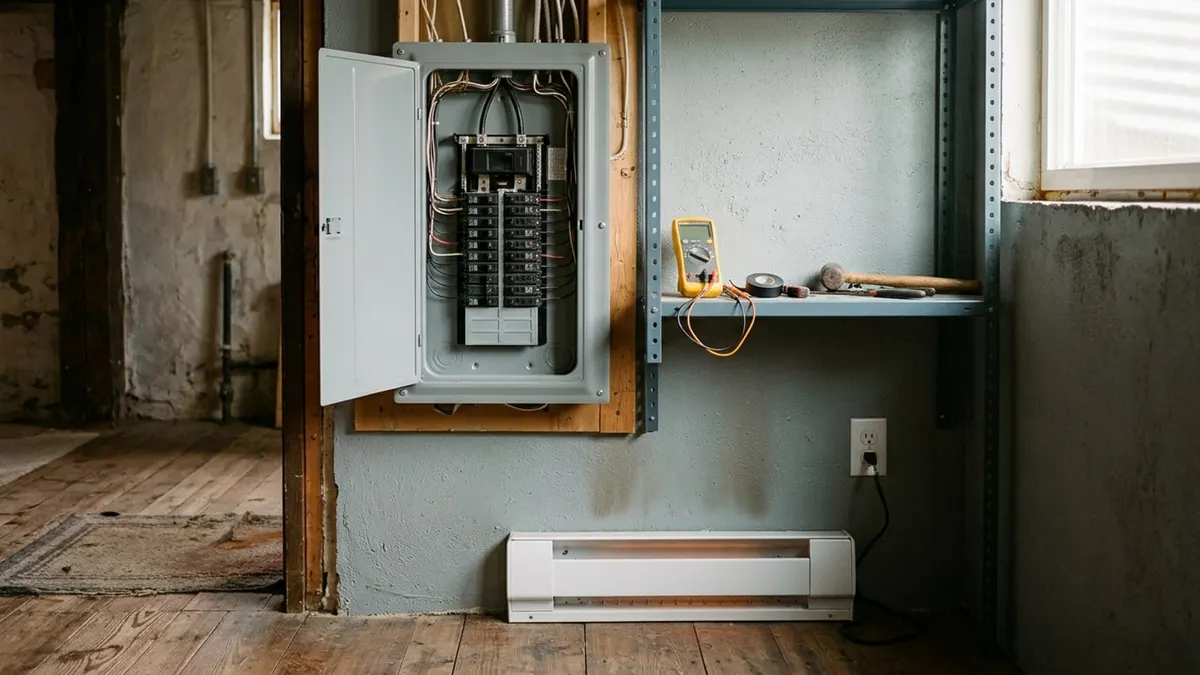
Baseboard Heater Calculator: Amps, Circuit Size and BTU
Enter the heaters' watts and voltage: the calculator gives the amps, the circuit size King Electric's 125% rule calls for, and how many watts a 15 or 20 amp circuit can carry.
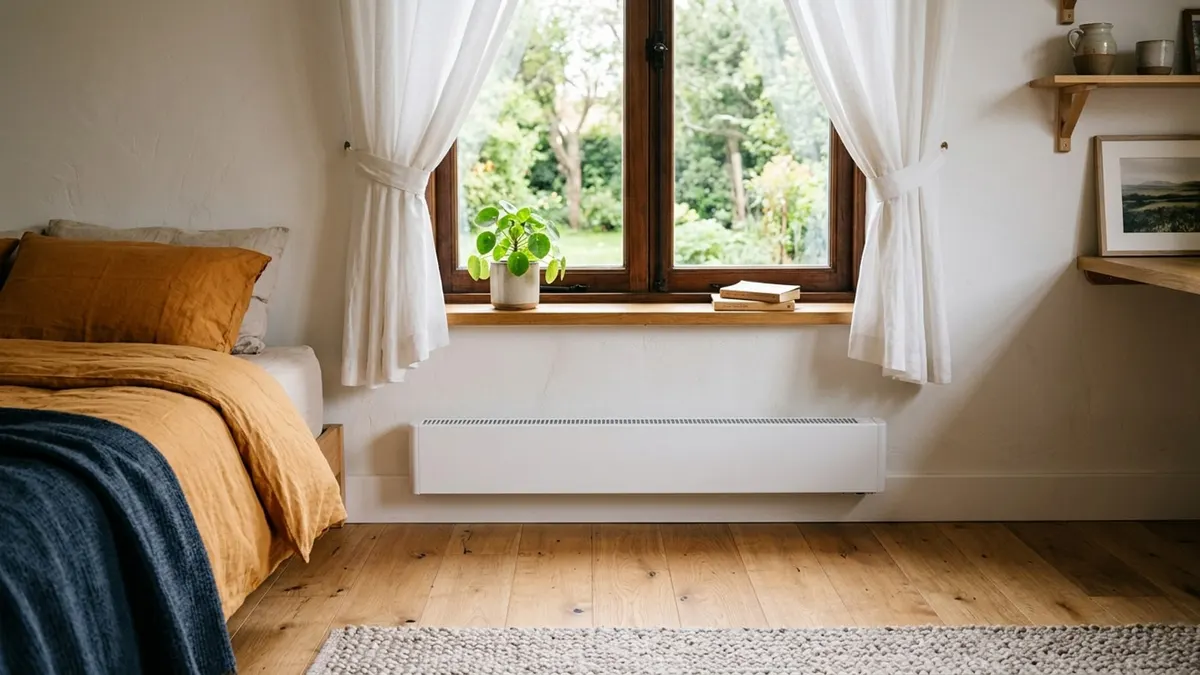
Best Electric Baseboard Heaters (2026): Hardwired and Plug-In Picks
The Cadet F series is our pick: a full-length overheat cutoff, wattages from 500 to 2,500, and a guide that spells out where it may and may not go. Each needs a thermostat.

Best Electric Hydronic Baseboard Heaters (2026): Oil-Filled Heat That Lingers
Cadet's SoftHeat is our pick: its element sits in a copper tube of mineral oil that holds heat after the heater cycles off, for steadier, gentler warmth than a standard baseboard.