
Best Electric Hydronic Baseboard Heaters (2026): Oil-Filled Heat That Lingers
Electric hydronic baseboard heaters compared: Cadet SoftHeat, the Fahrenheat FHP1500T portable, Qmark HBB1254 and a Dayton 120 volt model, with placement rules.

Affiliate disclosure: product links on this page go to Amazon or to the maker's own store. As an Amazon Associate we earn from qualifying purchases, at no extra cost to you; links to makers' own stores earn us nothing. No retailer or brand sees our picks before they are published or has any say in them. How we choose.
An electric hydronic baseboard looks like a standard baseboard, but its element sits in a sealed tube of fluid. Cadet explains that in its SoftHeat line the element is enclosed in a copper tube filled with mineral oil, and that the oil holds heat longer for more consistent, gentle warmth. Cadet says the result is a baseboard that stays warm after it cycles off; no boiler or plumbing is involved, since the fluid never leaves the heater (Cadet; our reading).
Cadet's SoftHeat EBHN750W is our pick: a 47 inch, 750 watt, 240 volt hydronic baseboard giving 2,560 BTU, or 563 watts and 1,925 BTU on 208 volts (per the listing).
Our top picks at a glance
- Cadet SoftHeat EBHN750W Hydronic Baseboard Heater
Type: Hardwired · Watts: 750 (563 at 208 V) · Volts: 240/208 · BTU/hr: 2,560 (1,925)
- Fahrenheat FHP1500T Portable Hydronic Baseboard Heater
Type: Plug-in · Watts: 1,500 · Volts: 120 · BTU/hr: 5,120
- Qmark HBB1254 Hydronic Baseboard Heater
Type: Hardwired · Watts: 1,250 · Volts: 240 · BTU/hr: Not stated
- Dayton 120V Hydronic Electric Baseboard Heater
Type: Hardwired · Watts: 1,500 (our arithmetic) · Volts: 120 · BTU/hr: 5,118
| Pick | Type | Watts | Volts | BTU/hr | Buy |
|---|---|---|---|---|---|
| Cadet SoftHeat EBHN750W Hydronic Baseboard HeaterBest overall | Hardwired | 750 (563 at 208 V) | 240/208 | 2,560 (1,925) | Amazon |
| Fahrenheat FHP1500T Portable Hydronic Baseboard HeaterBest plug-in | Plug-in | 1,500 | 120 | 5,120 | Amazon |
| Qmark HBB1254 Hydronic Baseboard HeaterBest long run | Hardwired | 1,250 | 240 | Not stated | Amazon |
| Dayton 120V Hydronic Electric Baseboard Heater120 volt hardwired | Hardwired | 1,500 (our arithmetic) | 120 | 5,118 | Amazon |
A hardwired oil-filled baseboard from a major heater maker.
- Type
- Hardwired
- Watts
- 750 (563 at 208 V)
- Volts
- 240/208
- BTU/hr
- 2,560 (1,925)
Pros
- Mineral oil in a copper tube holds heat (Cadet)
- Stays warm after cycling off (Cadet)
- Works with Cadet's built-in thermostat kit
Cons
- Thermostat sold separately
- Longer than a standard baseboard of the same wattage (our reading)
Cadet's SoftHeat EBHN750W is listed at 750 watts on 240 volts and 563 on 208, giving 2,560 or 1,925 BTU, in a 47 inch case.
Cadet's SoftHeat page explains that the element heats mineral oil in a copper tube, which holds heat longer and keeps the baseboard warm after it cycles off.
A portable hydronic baseboard for a 120 volt outlet.
- Type
- Plug-in
- Watts
- 1,500
- Volts
- 120
- BTU/hr
- 5,120
Pros
- 1,500 W and 5,120 BTU (manual)
- Built-in thermostat and pilot light switch
- Moves room to room
Cons
- Draws 12.5 amps; use its own circuit (our reading)
- Never on an extension cord (manual)
Fahrenheat's FHP1500T manual lists 1,500 watts, 120 volts, 12.5 amps and 5,120 BTU an hour, with a pilot light on-off switch and a temperature control thermostat; the FHP0750T is the 750 watt version.
The manual asks for at least 6 inches of clearance all round, the support legs fitted, and the plug pushed tightly into a wall outlet, since a loose or worn outlet can overheat.
Best long run
Qmark HBB1254 Hydronic Baseboard Heater
A 58 inch liquid-filled baseboard from Marley's Qmark line.
- Type
- Hardwired
- Watts
- 1,250
- Volts
- 240
- BTU/hr
- Not stated
Pros
- 58 inch liquid-filled case (per the listing)
- Thermal cutoff (per the listing)
- Marley installation manual
Cons
- 240 V hardwired only (per the listing)
- Supply wiring rated 90 C required (Marley)
Qmark's HBB1254 is a 58 inch, 1,250 watt, 240 volt liquid-filled baseboard with a thermal cutoff (per the listing).
Marley's instructions for its electric hydronic baseboards say the heater must be thermostatically controlled, never recessed, never below an outlet, and fed with supply wiring suitable for 90 C.
120 volt hardwired
Dayton 120V Hydronic Electric Baseboard Heater
A commercial-grade hydronic baseboard on 120 volts.
- Type
- Hardwired
- Watts
- 1,500 (our arithmetic)
- Volts
- 120
- BTU/hr
- 5,118
Pros
- 5,118 BTU an hour (per the listing)
- Single phase 120 V
- Commercial build (per the listing)
Cons
- Thin listing
- 12.5 amps on a 120 V circuit
Dayton's 120 volt hydronic baseboard is listed at 12.5 amps and 5,118 BTU an hour, which is about 1,500 watts (per the listing; our arithmetic).
On a 120 volt, 20 amp circuit that is 12.5 of the 16 amps King's 80% rule allows (King; our arithmetic). See the circuit calculator.
Hydronic or standard baseboard
| Point | Hydronic | Standard |
|---|---|---|
| Element | In a fluid-filled tube (Cadet) | Bare fins in air (our reading) |
| After it cycles off | Stays warm (Cadet) | Cools quickly (our reading) |
| Heat per watt | Same: 1 watt makes 3.412 BTU (our arithmetic) | Same |
| Length per watt | Longer (our reading) | Shorter |
Both turn every watt into heat, so a 750 watt hydronic and a 750 watt standard baseboard give the same 2,560 BTU (Cadet; our arithmetic). The difference is how evenly the heat comes: the fluid smooths the swings as the thermostat cycles (Cadet; our reading).
Who hydronic baseboards suit
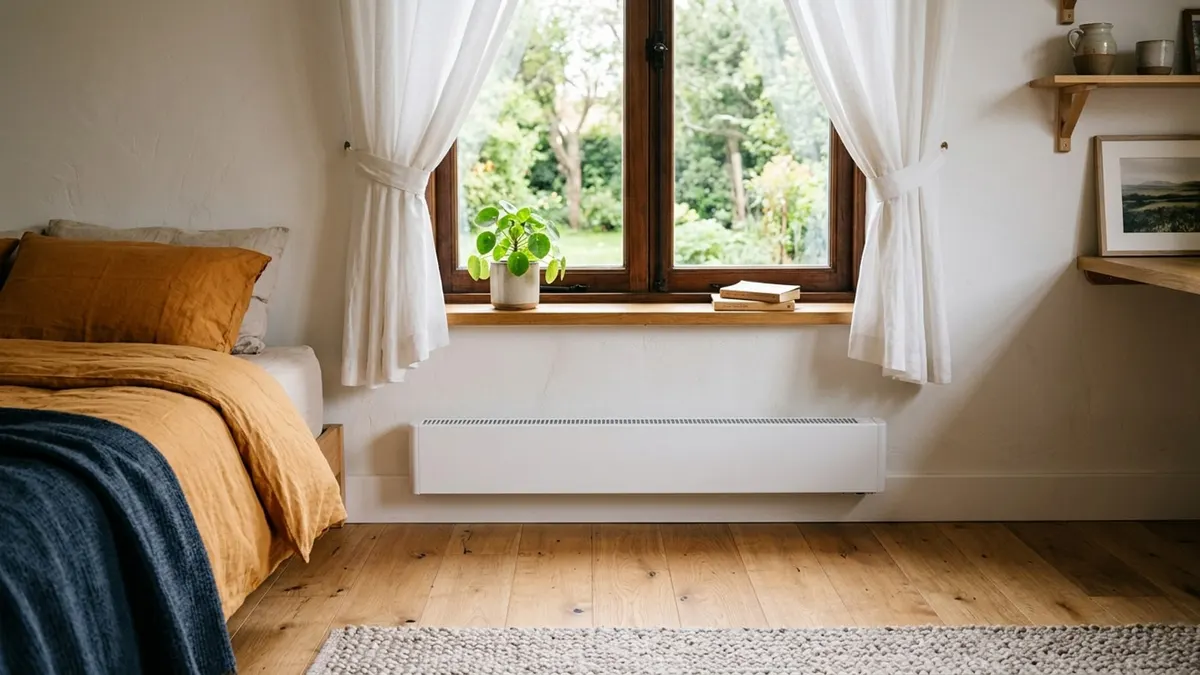
- Bedrooms and living rooms where the on-off swing of a standard baseboard is noticeable (Cadet; our reading).
- Rooms where a quiet, gentle heat matters more than how fast the room warms (Cadet; our reading).
- Renters or occasional rooms, with the plug-in Fahrenheat model (per the listing; our reading).
Placement rules
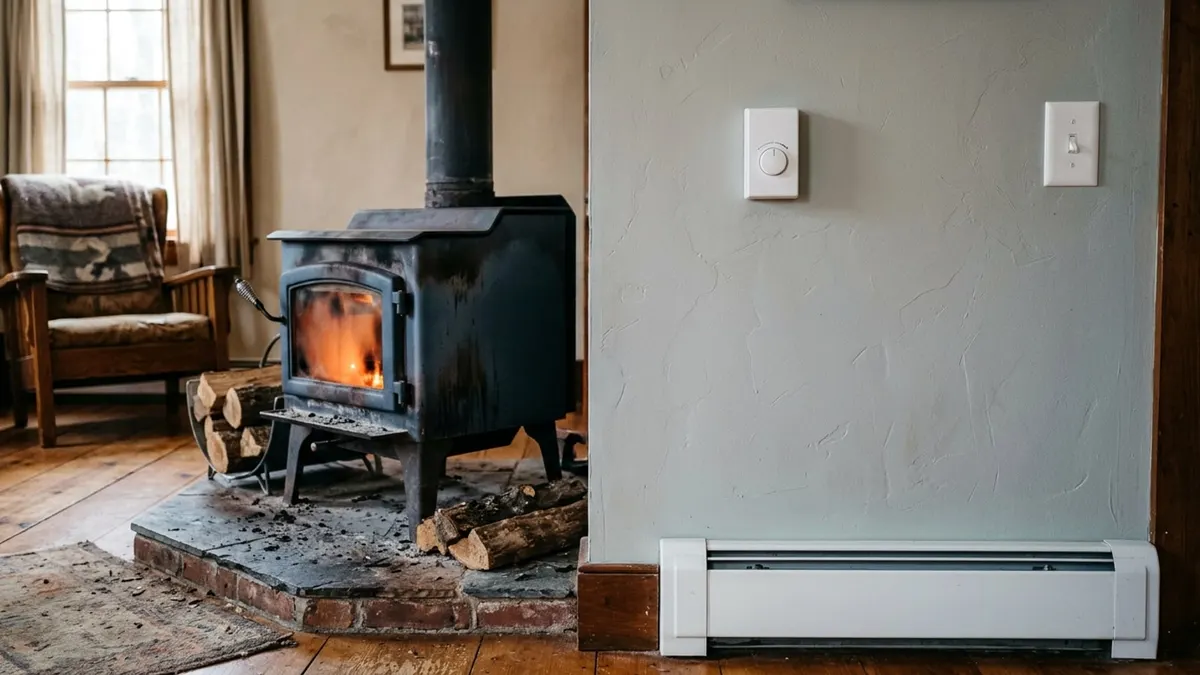
- Never below an electrical outlet (Marley, Cadet, King).
- Not against vinyl wallpaper, paperboard or low density fiberboard, and no vinyl drapes or blinds above (Marley).
- Not recessed into the wall (Marley).
- Keep cords, foam articles, drapes and bedding from touching it (Marley).
- At least 6 inches all round for the Fahrenheat portable (Fahrenheat).
Length for the wattage
Hydronic baseboards are longer for their output: Cadet's 750 watt SoftHeat is 47 inches, while its 750 watt F series standard baseboard is 36 inches (per the listing; Cadet spec sheet). Plan wall space for the extra length, especially under windows (our arithmetic; our reading).
The picks side by side
| Heater | Watts | Volts | Length |
|---|---|---|---|
| Cadet SoftHeat EBHN750W | 750 (563 at 208 V) | 240/208 | 47 in |
| Fahrenheat FHP1500T | 1,500 | 120 (plug-in) | 58 in (per the listing) |
| Qmark HBB1254 | 1,250 | 240 | 58 in |
| Dayton 120 V | About 1,500 | 120 | Not stated |
Fabrics and finishes
Marley warns that some fabrics discolor in time from indirect sunlight and heat, and says not to install its baseboards against vinyl wallpaper or below vinyl drapes or blinds. Leave space above the heater for drapes and keep them off the case (Marley; Cadet).
Portable hydronic heaters
A plug-in hydronic baseboard must go straight into a wall outlet, never an extension cord or power strip, Fahrenheat says, and its plug must fit tightly. It should be unplugged when not in use and kept out of bathrooms and laundry areas, the same instructions add.
First use
Fahrenheat says a new smell may come from the heater at first and suggests running it on its highest setting for a while so it burns off. A thermal safety switch shuts the element off if the heater overheats, then resets automatically once it cools, its sister FBE manual explains.
Wiring a hardwired model
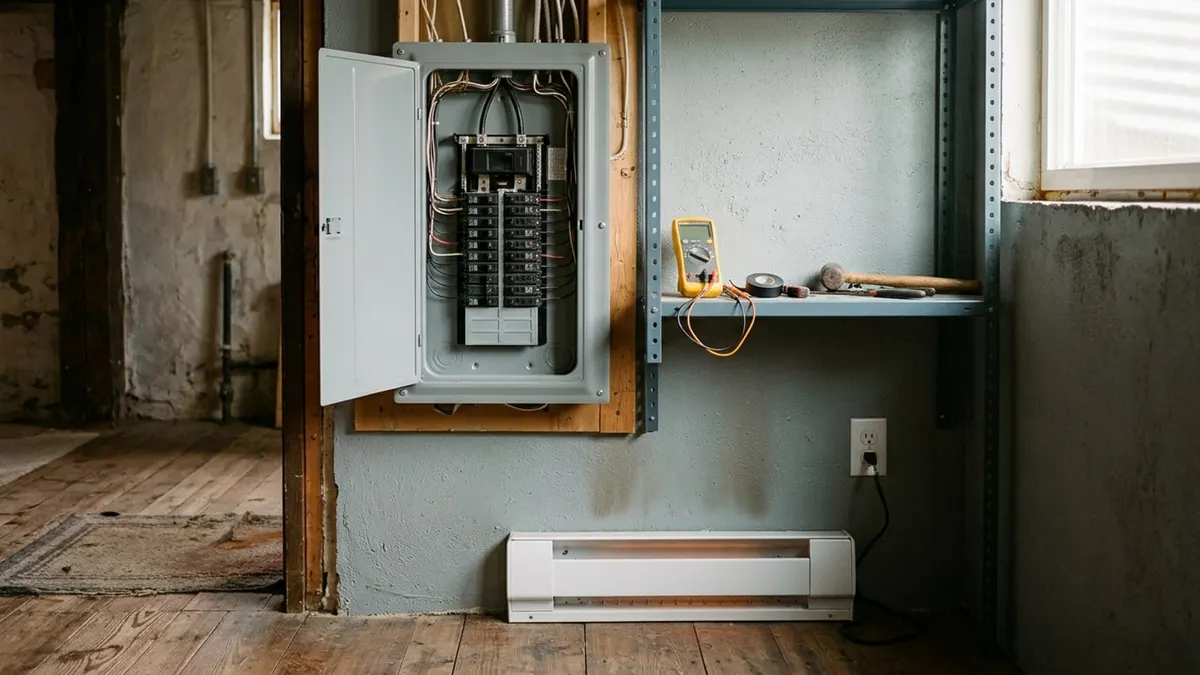
Marley asks for the total ampere load of all heaters on a branch circuit to be worked out from the nameplates before the wire and breaker are chosen, and for supply wiring rated 90 C. Have an electrician wire hardwired models; Cadet's own install pages suggest one if the wiring is unfamiliar. The circuit calculator adds up the load.
Thermostats
Hardwired hydronic baseboards need a line voltage thermostat; Mysa's LITE lists self-contained electric hydronic baseboards among the heaters it can run. See the thermostat guide.
Sizing and circuits
Size hydronic baseboards by watts like any electric heater, about 10 watts a square foot as a start (per the Stelpro listing; our arithmetic), and keep the circuit within King's 80% rule. See the baseboard heater guide for standard models.
Mixing types in one house
Hydronic and standard baseboards can share a house and even a thermostat if its rating covers the load; many owners put hydronic models in bedrooms and standard ones in hallways and utility rooms (our reading). Keep each circuit within King's 80% rule whatever the mix of heaters on it (King; our reading).
Running costs
A hydronic baseboard uses the same electricity per hour of heat as a standard one; the fluid evens out the heat rather than making more of it (Cadet; our reading). Savings come from the thermostat setting, the schedule and the insulation, not the type of baseboard (our reading).
Care
Fahrenheat asks for cleaning and inspection at least once a year, preferably at the start of the heating season, and says the heater needs no other preventive maintenance. Never drain or open a sealed hydronic heater; the fluid stays inside for the life of the unit (our reading).
Frequently asked questions
What is an electric hydronic baseboard heater?
A baseboard whose element sits in a sealed fluid-filled tube; Cadet's SoftHeat uses mineral oil in copper, which holds heat after it cycles off.
Are hydronic baseboards more efficient?
Not per watt: every watt makes the same heat. They give steadier warmth because the fluid holds heat (Cadet; our arithmetic).
Do electric hydronic baseboards need plumbing?
No: the fluid is sealed inside the heater; they wire in like any electric baseboard (Cadet; our reading).
Can a hydronic baseboard go under an outlet?
No: Marley, Cadet and King all say never below an electrical outlet.
How much clearance does a portable hydronic heater need?
Fahrenheat's FHP manual asks for at least 6 inches all round.
Sources
- SoftHeat hydronic baseboard heaters, Cadet
- FHP portable electric hydronic baseboard heater instructions, Marley Engineered Products (Fahrenheat)
- Electric/hydronic baseboard heaters (Model D) installation and maintenance instructions, Marley Engineered Products
- Sizing the Heater Circuit, King Electric
- Electric baseboard owner's guide (F series), Cadet
Related guides
Baseboard Heater Calculator: Amps, Circuit Size and BTU
Enter the heaters' watts and voltage: the calculator gives the amps, the circuit size King Electric's 125% rule calls for, and how many watts a 15 or 20 amp circuit can carry.
Best Baseboard Heater Thermostats (2026): Line Voltage, Programmable and Smart
Baseboards need a line voltage thermostat, not a 24 volt furnace one. The Stelpro SWT2F is our pick: a double pole, 22 amp dial that fully cuts power when turned off.
Best Electric Baseboard Heaters (2026): Hardwired and Plug-In Picks
The Cadet F series is our pick: a full-length overheat cutoff, wattages from 500 to 2,500, and a guide that spells out where it may and may not go. Each needs a thermostat.