
Best Electric Wall Heaters (2026): In-Wall Fan Heaters and Plug-In Models
Electric wall heaters compared on Cadet's spec sheets and install guide: Cadet Energy Plus, Com-Pak and Com-Pak Twin in-wall fan heaters and DREO's plug-in model.
Affiliate disclosure: product links on this page go to Amazon or to the maker's own store. As an Amazon Associate we earn from qualifying purchases, at no extra cost to you; links to makers' own stores earn us nothing. No retailer or brand sees our picks before they are published or has any say in them. How we choose.
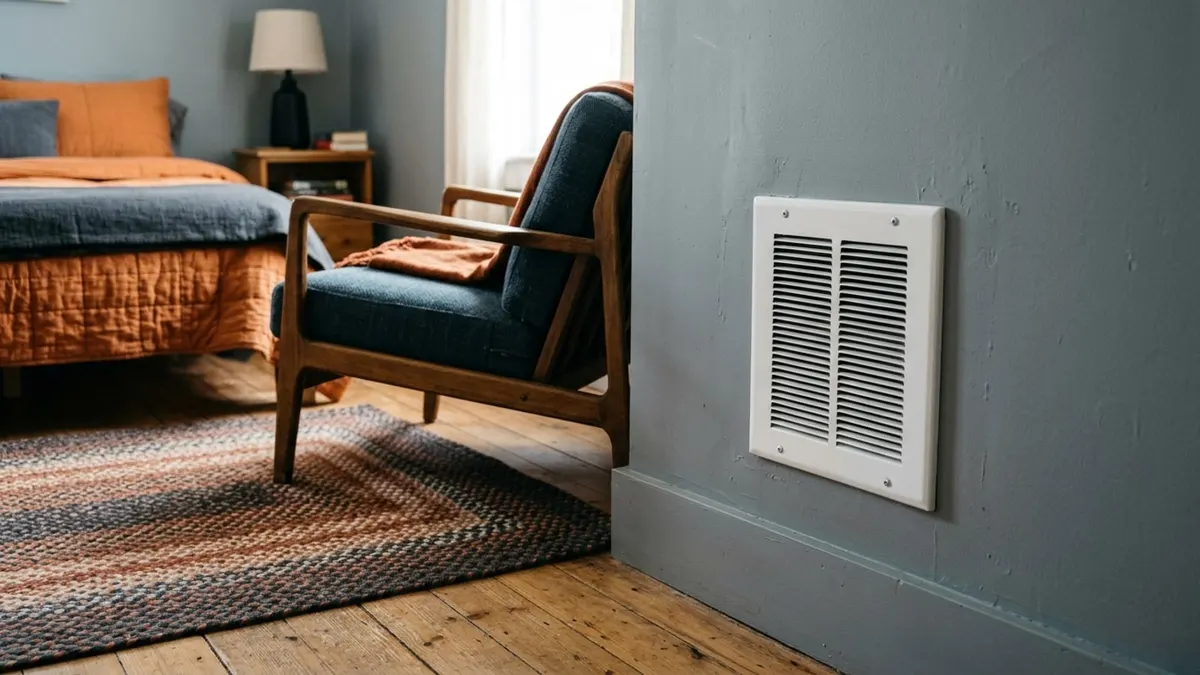
An in-wall fan heater blows warm air from a box set between the studs, so it heats a small room fast from a small footprint; Cadet's Com-Pak line comes as single, twin and bath models, assembled in the USA. Cadet's spec sheet sets the basic clearances: at least 6 inches from adjacent surfaces and 4 1/2 inches from the floor, as UL requires, 12 inches recommended, and 3 feet clear in front.
Cadet's Energy Plus is our pick: its listing says a variable-speed fan and digital control hold the room within a degree, that it senses 120, 208 or 240 volts and gives 1,000, 1,500 or 1,600 watts, and that it fits existing Com-Pak wall cans.
Our top picks at a glance
- Cadet Energy Plus Electric Wall Heater
Type: In-wall fan · Watts: 1,000, 1,500 or 1,600 · Volts: 120, 208 or 240 · Thermostat: Digital, built in
- Cadet Com-Pak CSC202TW Wall Heater
Type: In-wall fan · Watts: 2,000 (1,500 at 208 V) · Volts: 240/208 · Thermostat: Built in, 40 to 85 F
- Cadet Com-Pak Twin Wall Heater
Type: In-wall fan · Watts: 4,000 (3,000 at 208 V) · Volts: 240/208 · Thermostat: Built in, 40 to 85 F
- DREO Smart Wall Heater
Type: Plug-in wall mount · Watts: 1,500 · Volts: 120 · Thermostat: Digital, 41 to 95 F
| Pick | Type | Watts | Volts | Thermostat | Buy |
|---|---|---|---|---|---|
| Cadet Energy Plus Electric Wall HeaterBest overall | In-wall fan | 1,000, 1,500 or 1,600 | 120, 208 or 240 | Digital, built in | Amazon |
| Cadet Com-Pak CSC202TW Wall HeaterBest basic | In-wall fan | 2,000 (1,500 at 208 V) | 240/208 | Built in, 40 to 85 F | Amazon |
| Cadet Com-Pak Twin Wall HeaterBest for a large room | In-wall fan | 4,000 (3,000 at 208 V) | 240/208 | Built in, 40 to 85 F | Amazon |
| DREO Smart Wall HeaterBest plug-in | Plug-in wall mount | 1,500 | 120 | Digital, 41 to 95 F | Amazon |
Best overall
Cadet Energy Plus Electric Wall Heater
A digital fan heater that fits Com-Pak wall cans.
- Type
- In-wall fan
- Watts
- 1,000, 1,500 or 1,600
- Volts
- 120, 208 or 240
- Thermostat
- Digital, built in
Pros
- Auto-senses supply voltage (per the listing)
- Holds within 1 degree (per the listing)
- Tamperproof minimum and maximum (per the listing)
Cons
- Listing claims up to 30% less energy against a standard model
- Hardwired: electrician work
Cadet's Energy Plus, model CEC163TW, is a complete unit with heater, wall can, grille and digital controller, and its listing says it senses the supply and gives 1,000, 1,500 or 1,600 watts on 120, 208 or 240 volts, up to 5,460 BTU.
The listing says its variable-speed fan holds the room within one degree and uses up to 30% less energy than a standard wall heater; we cannot confirm that figure.
Best basic
Cadet Com-Pak CSC202TW Wall Heater
Cadet's standard Com-Pak with a built-in thermostat.
- Type
- In-wall fan
- Watts
- 2,000 (1,500 at 208 V)
- Volts
- 240/208
- Thermostat
- Built in, 40 to 85 F
Pros
- 6,825 BTU at 240 V (Cadet spec)
- Complete unit with wall can and grille
- Fits rooms up to 200 sq ft (per the listing)
Cons
- Hardwired 240 V: electrician work (our reading)
- 1-year limited warranty field
Cadet's spec sheet lists the CSC202TW at 2,000 watts and 6,825 BTU on 240 volts, or 1,500 watts and 5,120 BTU on 208, drawing 8.3 or 7.2 amps.
The listing gives a rough-in of 8 by 10 1/4 by 4 inches and says it warms up to 200 square feet; the thermostat dial runs from 40 to 85 degrees (Cadet spec).
Best for a large room
Cadet Com-Pak Twin Wall Heater
Two fan heaters behind one grille.
- Type
- In-wall fan
- Watts
- 4,000 (3,000 at 208 V)
- Volts
- 240/208
- Thermostat
- Built in, 40 to 85 F
Pros
- About 13,648 BTU (per the listing)
- Manual-reset high temperature shutoff
- Covers up to 750 sq ft (per the listing)
Cons
- Horizontal only, not ceiling or vertical (per the listing)
- Needs a large 240 V circuit
The Com-Pak Twin puts two fan heaters behind one grille for 4,000 watts at 240 volts or 3,000 at 208, about 13,648 BTU, with a built-in 40 to 85 degree thermostat and a manual-reset high temperature shutoff (per the listing).
Its listing says it must be installed horizontally on an interior wall, not vertically or on a ceiling, and wired by a qualified electrician. At 240 volts it draws about 16.7 amps (our arithmetic).
Best plug-in
DREO Smart Wall Heater
A wall-mounted plug-in heater with app control.
- Type
- Plug-in wall mount
- Watts
- 1,500
- Volts
- 120
- Thermostat
- Digital, 41 to 95 F
Pros
- No wiring; drilling guide included (per the listing)
- App, Alexa and Google control
- 120 degree oscillation
Cons
- Visible on the wall, not recessed
- One outlet's worth of heat
DREO's Smart Wall Heater is a 1,500 watt plug-in unit that mounts on the wall with an included drilling guide, with a 41 to 95 degree thermostat, 120 degree oscillation and a 24 hour timer (per the listing).
It works with the DREO app and Alexa or Google Home, and dims its display at night (per the listing).
Where a wall heater may go
- In a wall can, at least 6 inches from adjacent surfaces and 4 1/2 inches from the floor, as UL requires (Cadet spec sheet).
- Preferably 12 inches from all surfaces, which Cadet recommends for longer and cleaner performance.
- With 3 feet clear in front for furniture and other objects (Cadet spec sheet).
- Not behind a door, below a towel bar, or anywhere the air discharge may be blocked (Cadet install guide).
- Not above a bathtub or sink, and not in a shower stall; Cadet recommends at least 2 feet of clearance (Cadet install guide).
- On an inside wall, where wall heaters and thermostats work best (Cadet spec sheet).
Sizes and rough-in
| Model | Watts | BTU/hr | Amps |
|---|---|---|---|
| CSC202TW at 240 V | 2,000 | 6,825 | 8.3 |
| CSC202TW at 208 V | 1,500 | 5,120 | 7.2 |
| Com-Pak Twin at 240 V | 4,000 | About 13,648 | About 16.7 (our arithmetic) |
| Energy Plus | 1,000 to 1,600 | Up to 5,460 | Varies with voltage |
The Com-Pak's grille is 9 by 12 inches, and it needs a rough-in opening of 8 by 10 1/4 inches, 4 inches deep, between studs (Cadet spec sheet). A Com-Pak thermostat heater assembly needs a wall can and grille kit when bought separately (Cadet spec sheet).
Replacing an old heater
Cadet's install guide says to check the label of the old heater and verify that the supply wires carry the same voltage as the new one. The Energy Plus listing says it fits existing Com-Pak wall cans, so an older Cadet can be upgraded without patching the wall (per the listing).
Warranty
Cadet's install guide gives a 2-year extended warranty on Com-Pak heaters, while the CSC202TW listing's warranty field reads 1 year limited; check the paperwork in the box. Spraying paint or texture onto the element or blower voids it (Cadet).
Ceiling mounting
Cadet's spec sheet says Com-Pak models of 1,500 watts or less may be ceiling mounted, while the Com-Pak Twin's listing rules out ceiling and vertical mounting; follow the instructions for your model.
Bathrooms
Cadet makes bath models of the Com-Pak, and its install guide keeps any heater out of the shower stall and away from tubs and sinks. Plug-in heaters are a different matter: Fahrenheat's portable heater instructions say not to use them in bathrooms or laundry areas.
Plug-in wall heaters
A plug-in heater like DREO's is still a 1,500 watt load on a 120 volt outlet. Fahrenheat's portable heater instructions say to plug heaters straight into a wall outlet, never an extension cord or power strip, and that a loose or worn outlet can overheat. Mount it near its outlet, where the cord does not hang across a walkway or run behind furniture (our reading).
Thermostat ranges
The Com-Pak's built-in thermostat runs from 40 to 85 degrees (Cadet spec sheet), the DREO's from 41 to 95 with one degree steps (per the listing), and the Energy Plus lets you lock minimum and maximum settings (per the listing). A tamperproof range helps in rentals, offices and shared rooms where others adjust the heat (our reading).
Fan heater or baseboard in a bathroom
A fan heater warms a bathroom quickly before a shower and takes little wall space, which is why Cadet offers bath versions of the Com-Pak; keep it out of the shower area as its guide says (Cadet; our reading).
Altitude
The Com-Pak listing says these models work best at elevations under 10,000 feet, so check with Cadet before installing one higher.
Painting and texturing
Cadet's guide says the warranty is void if any material is sprayed on the element or blower, and asks you to mask the heater when painting or texturing the walls.
Circuits
A 2,000 watt, 240 volt heater draws 8.3 amps, and the 4,000 watt Twin about 16.7; King's 80% rule means the Twin alone needs more than a 20 amp circuit's 16 amps (Cadet; King; our arithmetic). See the circuit calculator.
Wall heater or baseboard
A fan heater warms a room quickly from a small grille, which suits bathrooms and small rooms; a baseboard runs silently along a wall (our reading). See the baseboard and hydronic guides.
Frequently asked questions
What is the best electric wall heater?
Our pick is Cadet's Energy Plus: digital control within a degree, auto-sensing 120, 208 or 240 volts, and a fit in existing Com-Pak wall cans, per its listing.
How far does a wall heater need to be from the floor?
At least 4 1/2 inches, and 6 inches from adjacent surfaces, as UL requires; Cadet recommends 12 inches from all surfaces.
Can a wall heater go in a bathroom?
Cadet makes bath models, but its guide says never in a shower stall or above a tub or sink, with at least 2 feet of clearance recommended.
Can I paint over a wall heater?
No: Cadet says spraying anything on the element or blower voids the warranty; mask it first.
How much room does a wall heater need in front?
Cadet's spec sheet asks for 3 feet clear in front for furniture and other objects.
Sources
- Com-Pak CSC series wall heater spec sheet, Cadet
- Com-Pak wall heater installation guide, Cadet
- Com-Pak fan-forced wall heaters, Cadet
- Sizing the Heater Circuit, King Electric
- FHP portable electric hydronic baseboard heater instructions, Marley Engineered Products (Fahrenheat)
Cover image: Illustration: Pellet Stove Review
Related guides
Baseboard Heater Calculator: Amps, Circuit Size and BTU
Enter the heaters' watts and voltage: the calculator gives the amps, the circuit size King Electric's 125% rule calls for, and how many watts a 15 or 20 amp circuit can carry.
Best Baseboard Heater Thermostats (2026): Line Voltage, Programmable and Smart
Baseboards need a line voltage thermostat, not a 24 volt furnace one. The Stelpro SWT2F is our pick: a double pole, 22 amp dial that fully cuts power when turned off.
Best Electric Baseboard Heaters (2026): Hardwired and Plug-In Picks
The Cadet F series is our pick: a full-length overheat cutoff, wattages from 500 to 2,500, and a guide that spells out where it may and may not go. Each needs a thermostat.