
Best Stove Pipe (2026): 6 Inch Pipe, Elbows and What the Manuals Require
Six inch stove pipe compared: Heat-Fab 22 gauge, Imperial BM0220, Stor 24 gauge and Imperial's elbow, with the manuals' rules on gauge, routing and clearance.

Affiliate disclosure: product links on this page go to Amazon or to the maker's own store. As an Amazon Associate we earn from qualifying purchases, at no extra cost to you; links to makers' own stores earn us nothing. No retailer or brand sees our picks before they are published or has any say in them. How we choose.
Stove pipe, or chimney connector, carries smoke from the stove's flue collar to the chimney, and it is where many installation mistakes happen. US Stove's US1100E manual calls for 6 inch black or blued steel pipe, a minimum of 24 gauge for a single-wall connector, a run that never passes through an attic, closet, floor or ceiling, and as few elbows as possible.
Heat-Fab's 22 gauge 6 x 48 inch pipe is our pick: 22 gauge cold rolled steel, a heavier gauge than the 24 gauge minimum, in a 48 inch length (per the listing).
Our top picks at a glance
- Heat-Fab 22 Gauge 6 x 48 Inch Black Stove Pipe
Diameter: 6 in · Length: 48 in · Steel: 22 gauge (listing) · Type: Single wall
- Imperial BM0220 6 x 48 Inch Black Stove Pipe
Diameter: 6 in · Length: 48 in · Steel: Not stated · Type: Single wall
- Stor 6 x 24 Inch 24 Gauge Stove Pipe, 3 Pack
Diameter: 6 in · Length: 24 in (3 pieces) · Steel: 24 gauge (listing) · Type: Single wall
| Pick | Diameter | Length | Steel | Type | Buy |
|---|---|---|---|---|---|
| Heat-Fab 22 Gauge 6 x 48 Inch Black Stove PipeBest overall | 6 in | 48 in | 22 gauge (listing) | Single wall | Amazon |
| Imperial BM0220 6 x 48 Inch Black Stove PipeCommon 48 inch length | 6 in | 48 in | Not stated | Single wall | Amazon |
| Stor 6 x 24 Inch 24 Gauge Stove Pipe, 3 PackBest short lengths | 6 in | 24 in (3 pieces) | 24 gauge (listing) | Single wall | Amazon |
Best overall
Heat-Fab 22 Gauge 6 x 48 Inch Black Stove Pipe
Heavier 22 gauge steel in a 48 inch length.
- Diameter
- 6 in
- Length
- 48 in
- Steel
- 22 gauge (listing)
- Type
- Single wall
Pros
- Heavier than the 24 gauge minimum (our reading)
- Cold rolled steel (per the listing)
- Long length means fewer joints
Cons
- Thin listing
- Single wall: full clearances apply
Heat-Fab's black stove pipe is listed as 22 gauge cold rolled steel, 6 inches by 48 inches; a lower gauge number means thicker steel, so it is heavier than the 24 gauge minimum US Stove names (per the listing; our reading).
A 48 inch section covers most runs from stove to ceiling support with fewer joints (our reading).
Common 48 inch length
Imperial BM0220 6 x 48 Inch Black Stove Pipe
A widely sold 6 x 48 inch black pipe.
- Diameter
- 6 in
- Length
- 48 in
- Steel
- Not stated
- Type
- Single wall
Pros
- 6 x 48 inch black steel (per the listing)
- Fits standard 6 inch kits (per the listing)
- Imperial also makes matching elbows
Cons
- Gauge not stated
- Listing contradicts itself on material
Imperial's BM0220 is listed as 6 by 48 inch black steel stove pipe for wood stove installations; one line of the same listing oddly calls it lightweight plastic, which stove pipe cannot be, so read it as steel and check the gauge stamped on the pipe (per the listing; our reading).
Imperial's BM0014 6 inch adjustable elbow matches it for the turn into a wall thimble (per the listing).
Best short lengths
Stor 6 x 24 Inch 24 Gauge Stove Pipe, 3 Pack
Three 24 inch, 24 gauge sections.
- Diameter
- 6 in
- Length
- 24 in (3 pieces)
- Steel
- 24 gauge (listing)
- Type
- Single wall
Pros
- Meets the 24 gauge minimum (per the listing)
- Three short sections for tight runs
- Matte black finish
Cons
- More joints than 48 inch pipe
- Thin listing
Stor's pack is three 6 by 24 inch, 24 gauge single-wall steel sections in matte black (per the listing).
Short sections suit low ceilings and offsets, though every extra joint must be fastened and checked (our reading).
What the manuals require
- The same diameter as the stove's flue collar; US Stove's stoves take 6 inch pipe, and a flue smaller than the stove's exhaust causes draft problems (US Stove).
- Black or blued steel; US Stove's manuals give 2,100 degrees as the pipe type rating (US Stove).
- A minimum 24 gauge single-wall steel connector (US Stove).
- Never through an attic, roof space, closet, concealed space, floor or ceiling; use listed chimney parts there (US Stove).
- Short, with few elbows: two 90 degree elbows cool the gases and build creosote (US Stove).
Single wall or double wall
Single-wall pipe needs the full clearances the stove's manual gives to walls and ceilings. Double-wall, close clearance pipe such as DuraVent's DVL needs only 6 inches to walls and 8 inches to the ceiling, measured at right angles to the pipe, and can be used anywhere single-wall pipe is allowed, DuraVent says. DuraVent adds that DVL must not be mixed with single-wall pipe or other makers' parts.
Picking parts for a typical run
| Part | Example | Note |
|---|---|---|
| Pipe from the collar | Heat-Fab 6 x 48 | Fasten to the collar with screws |
| Short filler | Stor 6 x 24 | Trim the length to suit |
| Elbow, if the stove exits at the back | Imperial BM0014 | Each elbow cools the gases (US Stove) |
| Ceiling support and chimney | Listed chimney parts | Never single-wall through the ceiling (US Stove) |
Imperial's adjustable elbow turns the run toward a wall thimble when the stove sits in front of a wall (per the listing; our reading).
Assembly
- Plan the run on paper: stove collar, any elbow, the ceiling support or wall thimble, and the chimney (our reading).
- Fit each section with its crimped end down toward the stove, so condensed creosote runs back into the stove rather than out of the joint (our reading).
- Fasten every joint with sheet metal screws, including the joint at the flue collar (our reading).
- Check the clearances from the pipe to walls and ceiling against the stove manual before the first fire (US Stove).
A thermometer on the pipe
US Stove asks for a magnetic thermometer on single-wall pipe about 18 inches above the stove, and for its reading to stay below 475 degrees during the first curing fires. See the thermometer guide.
Floor protection under a horizontal run
Where pipe runs horizontally, US Stove's US1100E manual asks for floor protection under it, reaching 2 inches beyond each side of the pipe.
What not to add
- No barometric draft stabilizer on US Stove's stoves; its manuals prohibit one.
- No connection to a hot air duct or distribution system (US Stove).
- No mixing of double-wall DVL with single-wall pipe or other makers' parts (DuraVent).
- No shared flue with another appliance unless the manuals allow it (our reading of US Stove and DuraVent).
Permits and mobile homes
DuraVent's DVL instructions tell installers to check with local building or fire officials about permits, restrictions and inspection. In mobile homes, DuraVent says solid fuel appliances must be listed and carry the label of a testing agency approved by HUD, and installed exactly as their instructions say.
First fires
New black pipe smokes a little on its first fires as the finish cures, DuraVent notes, and the smell goes after a few uses. Open a window and run the first fires low to medium, as US Stove asks for curing its stoves (DuraVent; US Stove).
Pellet stoves are different
Pellet stoves never use single-wall stove pipe: DuraVent says single-wall pipe must not be connected to a freestanding pellet stove, which needs Type L or PL pellet vent. See the pellet vent guide.
Lengths and cutting
Plan the run with full standard lengths where you can and cut only the last section, since every cut end must be trimmed square and fastened; a telescoping or adjustable section avoids cutting, as DuraVent's DVL line offers (DuraVent; our reading).
Black or blued
US Stove's manuals accept black or blued steel; both are painted or heat-treated steel rated for stove temperatures, and the choice is mostly about looks. Stainless pipe, like LEIFIDE's sold in pairs, is another option on Amazon (US Stove; our reading).
Checking the pipe each season
- Look for rust, pinholes, warping or bulges, and replace any damaged section before the season starts (our reading).
- Check that every screw is still tight and the joints have not separated, sagged or pulled apart at the collar (our reading).
- Look inside each section for creosote; US Stove says cooler surfaces build deposits and that creosote should be removed to cut the risk of a chimney fire.
Inspection and cleaning
The U.S. Fire Administration says to have chimneys cleaned and inspected each year by a professional, and US Stove's manual says the chimney should be inspected regularly and cleaned when used regularly. See the sweep kit guide and the installation guide.
Frequently asked questions
What size stove pipe do I need?
The same diameter as the stove's flue collar; US Stove's US1100E and TH-100 take 6 inch pipe, and a smaller flue causes draft problems.
What gauge stove pipe should I use?
At least 24 gauge for a single-wall steel connector, per US Stove; 22 gauge is heavier steel.
Can stove pipe go through a ceiling?
Not single-wall connector pipe: US Stove says never through an attic, closet, floor or ceiling; use listed chimney parts there.
How close can double-wall stove pipe be to a wall?
DuraVent's DVL needs 6 inches to walls and 8 to the ceiling, measured at right angles to the pipe.
Can I use stove pipe on a pellet stove?
No: DuraVent says never connect single-wall pipe to a freestanding pellet stove; use listed pellet vent.
Sources
- US1100E (Defender II) owner's instruction and operation manual, United States Stove Company
- TH-100 owner's instruction and operation manual, United States Stove Company
- DVL double-wall, close clearance connector installation instructions, DuraVent
- PelletVent installation instructions, DuraVent
- Heating Fire Safety, U.S. Fire Administration
Related guides
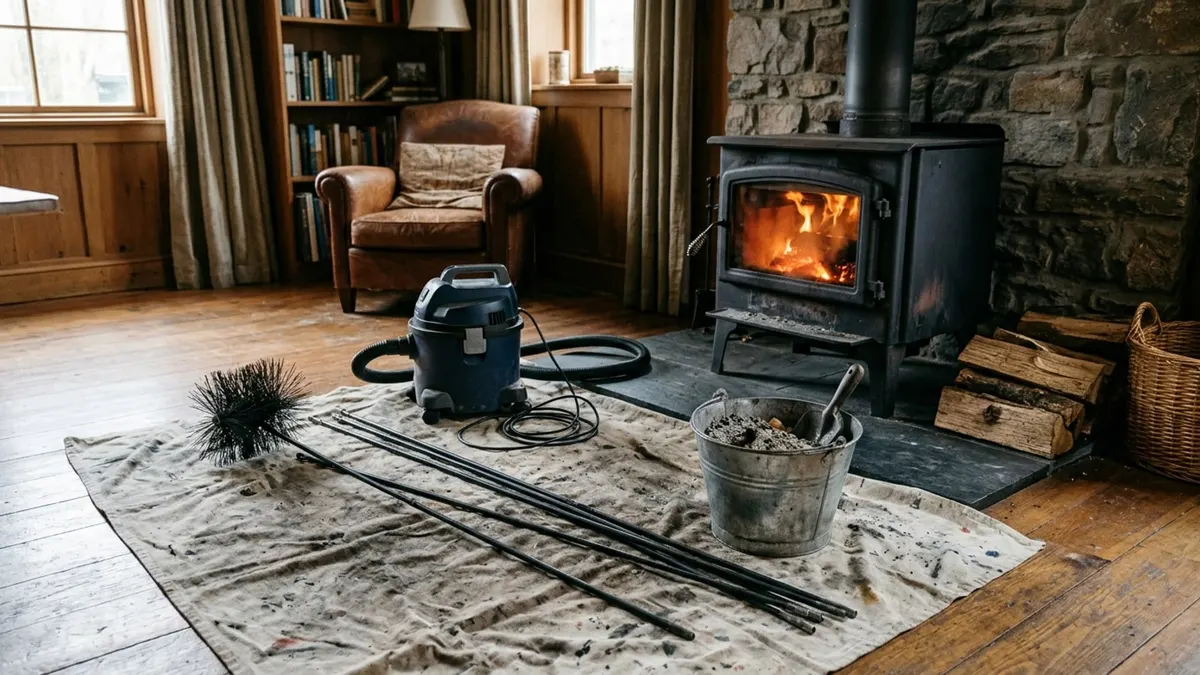
Best Chimney Sweep Kits (2026): Rods, Brushes and Pellet Vent Brushes
Sealegend's 30 foot rotary kit is our pick for a stove chimney: nylon brush on 9 rods that turns on a drill. Sweep between the yearly professional inspections, not instead of them.

Best Pellet Stove Vent Pipe (2026): Type L Kits, Pipe and Clean-Out Tees
DuraVent's PelletVent 3 inch kit is our pick: UL 641 Type L vent in a kit. Pellet stoves need listed 3 or 4 inch Type L or PL vent, never single-wall pipe.

Chimney Liners for Stoves and Inserts: Sizes, Stainless Kits and Rules
Inserts and many stoves vent through a stainless liner run inside the old chimney. Size it to the appliance's flue, not the chimney, and have the masonry inspected first.